I was my parents’ first, special baby. Two years later my brother was born. When we heard him crying in the room next door, my father asked me, “What is that?” I quickly reassured him, “Toemaar, Pa, dis net ‘n muskiet.” (Never mind, Pa, it’s only a mosquito.) Mosquitoes go away but no such luck here. In future I had to work harder to be special.
My Oom Tom, my Calvinist Ouma’s brother was the high achiever in their family. He was Professor of Psychology in a leading university and his academic field concerned educating children of character. When Oom Tom came to visit and I was introduced to him while sitting on my mother’s hip. He was carrying a box of matches which he shook and then handed to me. I took the box, shook it, and handed it back to him. He was delighted: “She’ll do well!” I heard that.
Our cattle farm was too isolated for us to go to school but my mother was a teacher. As we sat under a thorn tree where the cattle had been herded in for branding, in a smoothed patch of soil my mother taught me to write numbers. “Here is a 1, and here is a 2.” The 2 was difficult for me. I scrubbed over the numbers. “Show me how to write 1,000”, I said. I had to be better than the mosquito sleeping in his pram next to us.
Of course, I don’t remember these things, they were the stories told about me by my parents. They set the scene.
During the Second World War, and well after the war, there was no petrol and we were totally isolated on this large property, 200 km from the nearest small town. My father had an intellectual bent. I don’t know how he managed it but he persuaded the pilot of the plane that carried the weekly mail from Pretoria to Southern Rhodesia (now Zimbabwe) to drop a packet of newspapers on our farm. My father went out on horseback scouring the bush to find the package. I sat on the horse in front of him. He devoured those newspapers. It was a bit of a struggle for me because some of them were in English. Was the struggle worth it?
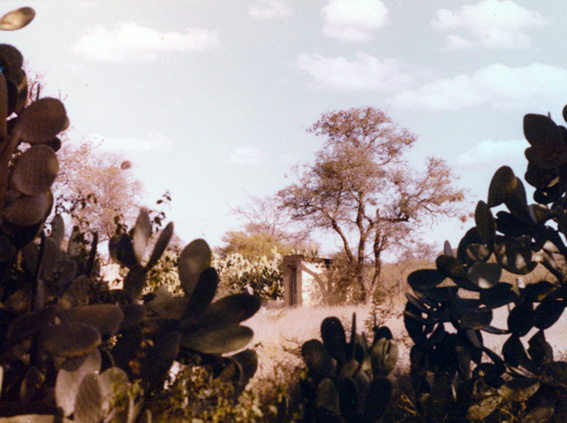
The thing that spoilt my early life, apart from the mosquito, now known as Klein Boetie, was the longdrop toilet, located 100 metres from the house, behind prickly pear bushes where snakes and scorpions lived. There was a gap at the base of the toilet door to provide ventilation. The smell was awful and if I shone a torch down the hole I could see wriggling worms but I did rather like the lizards that crept along the corrugated iron roof. When my father was recovering from malaria, still weak, he struggled to this toilet and sank down onto the seat. Behind the door was a black mamba, a hugely venomous snake. My father froze. There he sat for the next hour, face-to-face with the mamba, praying that none of us would come to look for him. Eventually it slithered out through the gap below the door. It was days before I could be persuaded to use this toilet again.
On one of our rare visits to the nearest town, we stopped off at the home of friends who were well-off and who had just built a new house. There, at the end of a corridor was a room into which I was ushered. There was my first flush toilet. It was a dream come true! My mother sniffed: “It will make the whole house smelly.” But my sights were set on that toilet. One day I would have a flush toilet. I would never be without a flush toilet ever again. One day I would spread the word so that the whole world could have flush toilets, even the poorest people.
My ambition was set. I was on my way. Even then I realised that I would need to be educated in something or other relevant to toilets. First I needed to read those newspapers, I needed to read English. Just as well I knew how to write 1000.